
More reasons to enroll early: Save $250 on tuition + 50% off your deposit. Enroll by Oct 31.
Test perception and memory while keeping a gratitude journal in this 2-week psychology academy for high school students at UT Austin.
Rated 4.5 out of 5 for classroom experience by students who took this course in 2026.
Course Description
An illusion can fool your eyes; a memory can change with context. Try the experiments and ideas that help psychologists investigate experiences that feel familiar.
In this course you will explore the scientific foundations of psychology through observations, experiments, discussion, and reflection. A personality activity exploring five broad traits and a nature-versus-nurture discussion introduce individual differences. Illusions, biases, heuristics, and a memory experiment put perception and thinking to the test.
Compare classical and operant conditioning, examine stress responses and the neurobiology of emotion, and consider how development shapes thought and behavior. A daily gratitude journal connects positive psychology with mental wellbeing. Therapy and growth, attachment, groupthink, conformity, the bystander effect, signature strengths, and psychology careers broaden the picture.
A visit to the Blanton Museum offers another setting for observation and interpretation. Quizzes and reflection papers ask you to explain evidence, reconsider an assumption, and connect ideas across the academy. The interest is in looking beyond the first explanation for how people think, feel, and act.
This two-week full-day academy for high school students takes place at the University of Texas at Austin in Austin, Texas and is available to residential and commuter students. The program is developed by UT Austin and offered in partnership with Summer Discovery.
What You Will Do
• Set up and maintain a daily gratitude journal
• Examine five broad personality traits and differences between people
• Test perception and memory through illusions, biases, heuristics, and an experiment
• Compare conditioning, stress responses, neurobiology, and emotion
• Analyze attachment, groupthink, conformity, and the bystander effect
• Apply observation and interpretation during a visit to the Blanton Museum
Learning Outcomes
By the end of the course, students will be able to:
• Explain major ideas in development, perception, cognition, memory, behavior, and neuroscience
• Apply psychological principles to questions about relationships, resilience, and wellbeing
• Compare psychological explanations using evidence from observations, experiments, and discussion
You’ll leave with your completed gratitude journal, reflection writing and a certificate of completion.
Why Psychology Skills Matter
Psychology skills help students examine behavior without settling for the first explanation that comes to mind. Using the scientific method, comparing theories, and distinguishing observation from interpretation build careful reasoning that supports research, writing, and discussion.
The field also asks students to consider context. Development, personality, memory, emotion, relationships, and social influence can work together in complicated ways. Learning to weigh those factors helps students communicate with greater precision, question assumptions, and approach human behavior with both curiosity and care.
Who Should Attend?
For students who have completed 9th, 10th, 11th, or 12th grade.
Memory, personality, emotions, and relationships all offer ways into this broad introduction to psychology. The academy suits students who want to connect everyday behavior with scientific questions. A daily journal, experiments, short reflection writing, quizzes, and discussion of sensitive topics are part of the experience.
Your Summer at University of Texas at Austin
Studying on UT Austin’s Forty Acres campus gives high-school students a substantive introduction to academic life in Austin, Texas. Courses draw from popular undergraduate fields and Austin specialties. Full-day academies offer concentrated study, while classes across the program take place in campus classrooms and laboratories and may include guest speakers and fieldwork around Austin.
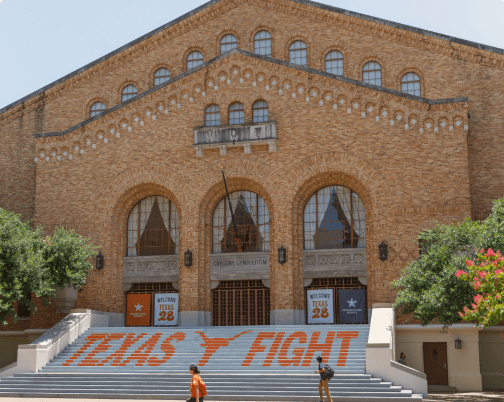
The experience extends beyond class for both residential and commuting students. Residential students live in Jester Hall, eat at J2, a popular campus dining hall, and take part in activities that may range from a star party at PMA to time at Gregory Gym, Zilker Park, South Congress, or an Austin FC match. Students gain independence, meet peers, and leave with a clearer view of college life, possible directions for future study, and what it can feel like to be a Longhorn.

UT Austin Certificate of Completion
After successfully finishing this course, you will be awarded a certification completion for your accomplishment.
*This is a preview, not what you will receive