
More reasons to enroll early: Save $250 on tuition + 50% off your deposit. Enroll by Oct 31.
Design a medical technology proposal in this 3-week stem cell medicine program for high school students on Yale University’s campus.
Rated 4.3 out of 5 for overall experience by students surveyed across the broader program in 2026.
Course Description
A new medical technology has to do more than sound promising. Examine the research, the disease it might address, and the people who could benefit.
In this course you will study stem-cell biology and clinical evidence. Sensitivity and specificity help describe how well a test detects or rules out a condition; clinical significance asks whether a finding matters in care. The story of Henrietta Lacks, whose cells have been widely used in research, opens a debate about ownership of cell lines.
Map immune responses and investigate transplantation, blood disorders, and CRISPR gene editing. A genetics game about an inherited blood disorder, blood-smear activity, and donor-recruitment campaign give those concepts practical questions. Research a gene-editing application using CRISPR and explain its possible medical use.
Organ investigations extend the work. Build lung models, graph heart-rate data, analyze gastrointestinal diseases, and weigh which patient should receive a kidney using researched policy and evidence. Examine liver-transplant criteria, trace neurological lesions, and design a brain prosthetic before joining a simulated stem-cell ethics board.
For your capstone, propose a new use for stem-cell research or another medical technology to address a specific disease. Explain what goes wrong in the body, the proposed solution, feasibility, accessibility, public-health effects, and future challenges. The presentation connects scientific possibilities with the decisions that shape their use.
This three-week course for high school students is part of Summer Discovery’s Institute for the Gifted program on Yale University’s campus in New Haven, Connecticut. Residential and commuter options are available.
What You Will Do
• Interpret stem-cell research and practice evaluating clinical significance
• Debate tissue ownership, transplantation and medical-ethics cases
• Model immune responses and investigate blood disorders through genetics activities
• Research a gene-editing application using CRISPR and explain its possible medical use
• Build organ-system models and analyze heart, lung, kidney, liver and brain cases
• Design and present a disease-focused medical technology proposal
Learning Outcomes
By the end of the course, students will be able to:
• Explain how stem cells and selected medical technologies may address disease
• Evaluate treatment ideas using research, ethical principles, and public-health considerations
• Support a disease-focused technology proposal with biological evidence and realistic limits
You’ll leave with your research analyses, capstone medical-technology proposal, and a certificate of completion.
Why Medical Innovation Skills Matter
Medical innovation depends on the ability to connect molecular science, clinical evidence and patient need. Students practice interpreting research rather than treating a new technology as automatically effective. They consider the quality of evidence, the biology of a disease and the limits of a proposed treatment.
Ethical and policy questions develop another kind of reasoning. Tissue ownership, organ allocation and access to expensive therapies require students to weigh competing principles and justify a decision. That combination of science, evidence and human impact supports deeper study in medicine, biology, bioengineering, public health and health policy.
Who Should Attend?
For students who have completed 9th, 10th, 11th, or 12th grade.
If you’re drawn to new treatments and want to understand the science and decisions behind them, this course brings both into view. Cell biology, genetics, biotechnology, and medical ethics all connect with the question of how research reaches patients.
You’ll work with scientific terminology, interpret evidence, discuss complex cases, and revise a substantial independent proposal. Institute for the Gifted eligibility requirements apply; see the program FAQ.
Recommended by Nearly 9 out of 10 Students
Based on students surveyed in 2026 about Summer Discovery programs at Yale University campus.
Your Summer at Yale University
The Institute for the Gifted program takes place on Yale University’s campus in New Haven, Connecticut.
The campus’s courtyards, architecture, libraries, and academic spaces create a vivid setting for learning beyond a familiar school environment, while New Haven’s connections to law, theater, science, and the arts extend that context into the city. Students learn alongside peers with similar interests, navigate campus life, and gain independence through everyday choices. The experience creates space to deepen an interest, test it in a more advanced setting, and consider what they may want to study or pursue next.
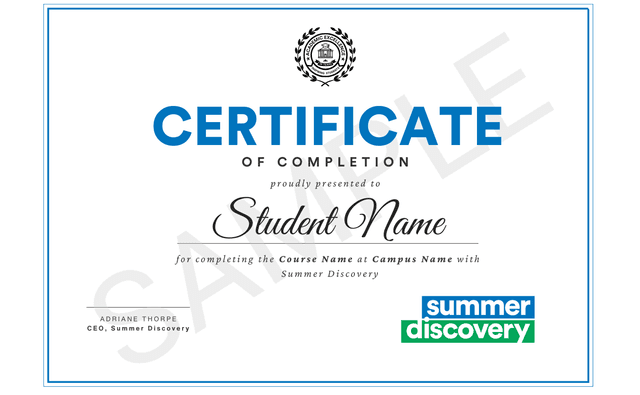
Summer Discovery Certificate of Completion
After successfully finishing this course, you will be awarded a certification completion for your accomplishment.
*This is a preview, not what you will receive