


More reasons to enroll early: Save $250 on tuition + 50% off your deposit. Enroll by Oct 31.
Develop a medical research proposal in this three-week medical research academy for high school students on Yale University’s campus.
Rated 4.3 out of 5 for overall experience by students surveyed across the broader program in 2026.

Course Description
A healthcare claim becomes more useful when you can trace it back to the evidence. Start with a question in medicine or public health and design a study that could investigate it.
Examine scientific literature, research ethics, data collection, analysis, and community-engaged research. The PICO framework helps you specify a population, intervention, comparison, and outcome. A literature scavenger hunt gives you practice judging sources, while a data challenge asks you to interpret what the results show. Consider the budget and ethical choices behind a study, then develop a proposal, abstract, and professional scientific poster for a symposium-style presentation.
Continue afterward through Polygence’s Core Research Program. Join a virtual cohort and work one-to-one with a mentor matched to your field. Across 10 virtual sessions, develop the project at an individual pace toward an appropriate final format, such as a research paper, business plan, science fair project, symposium presentation, or podcast. The two-part experience connects your on-campus research plan with a continuing mentored investigation.
This three-week full-day academy for high school students is part of Summer Discovery’s Institute for the Gifted program on Yale University’s campus in New Haven, Connecticut. Students focus on one academy for the full campus program. Residential and commuter options are available.
Total cost includes the Summer Discovery on-campus program fees and Polygence tuition.
What Will You Do?
• Trace a medical or public-health claim to relevant scientific literature
• Write a focused question using the PICO framework
• Compare methods, data, budget, and ethical safeguards for a study
• Interpret evidence through a literature scavenger hunt and data challenge
• Develop and defend a proposal, abstract, and professional scientific poster
• Continue through 10 one-to-one virtual Polygence mentor sessions
Learning Outcomes
By the end of the course, students will be able to:
• Formulate a researchable health question using scientific literature
• Choose and justify ethical methods suited to a proposed study
• Communicate a research plan with clear evidence and reasoning
You’ll leave campus with your medical research proposal, abstract, scientific poster, and a continuation plan for Polygence mentorship, with clearer direction for further investigation.
Why Medical Research Skills Matter
A medical research claim depends on the question asked, the people or evidence studied, and the method used. Reading literature and specifying a PICO question help students examine those connections. A finding becomes easier to assess when the reasoning behind the study is clear.
Research planning also involves choices about data, ethics, and resources. Students practice explaining why an approach fits a question and how its limitations might affect a conclusion. Presenting a proposal invites other people to question those choices. These habits support further study in medicine, public health, and other fields where evidence needs careful interpretation.
Who Should Attend?
For students who have completed 9th, 10th, 11th, or 12th grade.
This academy may interest you if you want to investigate a question in medicine or public health and understand how researchers develop evidence. You’ll examine literature, consider methods and ethics, and explain a research proposal to others. Students should be ready to revise a question and support a choice with reasons. The experience includes the on-campus academy and a subsequent Polygence program with 10 virtual mentor sessions, so participation extends beyond the time spent on campus.
Institute for the Gifted eligibility requirements apply; see the program FAQ.
Recommended by Nearly 9 out of 10 Students
Based on students surveyed in 2026 about Summer Discovery programs at Yale University campus.
Your Summer at Yale University
The Institute for the Gifted program takes place on Yale University’s campus in New Haven, Connecticut.
The campus’s courtyards, architecture, libraries, and academic spaces create a vivid setting for learning beyond a familiar school environment, while New Haven’s connections to law, theater, science, and the arts extend that context into the city. Students learn alongside peers with similar interests, navigate campus life, and gain independence through everyday choices. The experience creates space to deepen an interest, test it in a more advanced setting, and consider what they may want to study or pursue next.
Medical Research in Action
Medical and public-health research can investigate a treatment, a pattern in a population, or a question about how care is delivered. Each study needs methods suited to its purpose and ethical decisions about how evidence is gathered. A proposal helps make those decisions clear before the investigation begins.
Students encounter that process through literature, a focused question, and a research plan, then continue through Polygence mentorship. The project offers a way to explore which health questions hold their attention and how a final format can communicate the work. Further study begins with understanding what the evidence can and cannot support.
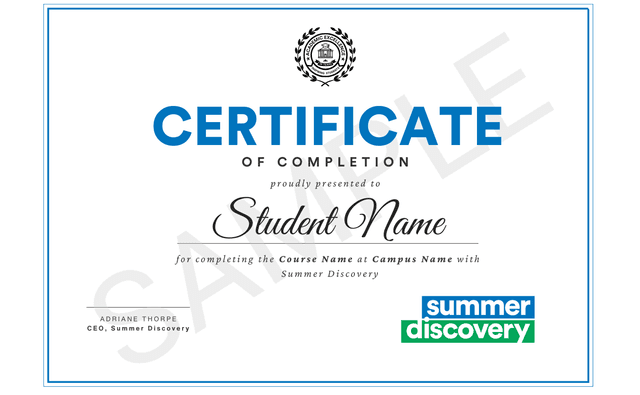
Summer Discovery Certificate of Completion
After successfully finishing this course, you will be awarded a certification completion for your accomplishment.
*This is a preview, not what you will receive