
More reasons to enroll early: Save $250 on tuition + 50% off your deposit. Enroll by Oct 31.
Model quantum behavior and present an original research capstone in this 3-week program for high school students on Yale University’s campus.
Rated 4.3 out of 5 for overall experience by students surveyed across the broader program in 2026.

Course Description
At the smallest scales, matter and light can behave in ways that everyday experience doesn’t prepare you for. Use simulations and mathematics to follow what the evidence says.
In this course you will investigate the double-slit experiment, wave-particle duality, superposition, measurement, and probability. Thought experiments such as Schrödinger’s cat raise questions about how to interpret those results.
Simulation labs let you vary conditions, observe interference patterns, and look for numerical relationships. Introductory work with wave functions and probability density gives you ways to describe a quantum state and its possible outcomes. Bra-ket notation, eigenvalues and eigenvectors, and the Schrödinger equation introduce more of the mathematical language behind the models.
Small-group presentations compare interpretations, including where models agree and where debate remains. For a capstone, choose a focused question in quantum theory or technology, gather reliable sources, and use equations or visualizations where appropriate. Quantum computing and decoherence are possible directions. An evidence-based explanation and final presentation ask you to make an unfamiliar idea clear while being honest about its limits.
This three-week course for high school students is part of Summer Discovery’s Institute for the Gifted program on Yale University’s campus in New Haven, Connecticut. Residential and commuter options are available.
What You Will Do
• Model the double-slit experiment and interference patterns
• Explore wave-particle duality, superposition, and measurement
• Use wave functions, probability density, and bra-ket notation
• Practice introductory eigenvalue and Schrödinger-equation reasoning
• Compare interpretations of foundational quantum thought experiments
• Research and present a focused quantum-physics capstone
Learning Outcomes
By the end of the course, students will be able to:
• Explain core quantum phenomena using evidence from experiments and simulations
• Interpret introductory mathematical representations of quantum states and probability
• Research and present a quantum question with appropriate limits and supporting evidence
You’ll leave with your simulation analyses, mathematical practice, original research capstone, and a certificate of completion.
Why Quantum Physics Skills Matter
Quantum physics teaches students to work carefully when intuition is unreliable. A simulation or equation becomes a way to test what a model predicts. Probability, vectors, and wave functions require students to interpret mathematical representations rather than memorize unusual claims.
Comparing interpretations also develops intellectual discipline. Students learn to separate an experimental result from a philosophical explanation and to state uncertainty honestly. These habits support advanced study in physics, mathematics, computer science, engineering, and any field where models must be judged against evidence.
Who Should Attend?
For students who have completed 9th, 10th, 11th, or 12th grade.
If an idea that challenges common sense makes you want to look closer, quantum physics offers plenty to investigate. This course suits students drawn to physics, mathematics, or quantum computing who want to use equations and visual models together.
You’ll work through unfamiliar notation, compare competing interpretations, and present a research-based explanation. Institute for the Gifted eligibility requirements apply; see the program FAQ.
Recommended by Nearly 9 out of 10 Students
Based on students surveyed in 2026 about Summer Discovery programs at Yale University campus.
Your Summer at Yale University
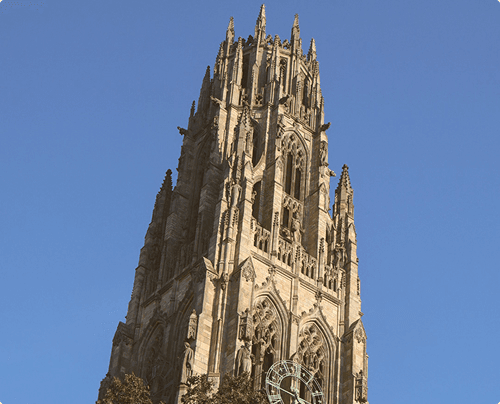
The Institute for the Gifted program takes place on Yale University’s campus in New Haven, Connecticut.
The campus’s courtyards, architecture, libraries, and academic spaces create a vivid setting for learning beyond a familiar school environment, while New Haven’s connections to law, theater, science, and the arts extend that context into the city. Students learn alongside peers with similar interests, navigate campus life, and gain independence through everyday choices. The experience creates space to deepen an interest, test it in a more advanced setting, and consider what they may want to study or pursue next.
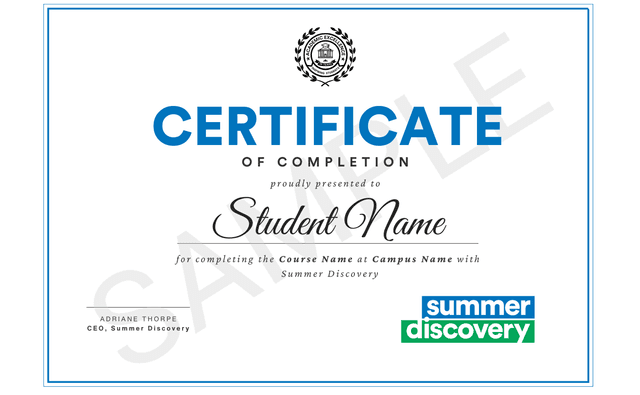
Summer Discovery Certificate of Completion
After successfully finishing this course, you will be awarded a certification completion for your accomplishment.
*This is a preview, not what you will receive