

More reasons to enroll early: Save $250 on tuition + 50% off your deposit. Enroll by Oct 31.
Test flight designs and present an aerospace innovation in this three-week aerospace engineering course for high school students on Yale University’s campus.
Course Description
A small change to a wing can change a flight. Build a glider, watch how it moves, and use the result to rethink your design.
In this course you will trace aerospace engineering from early aircraft to reusable rockets and future spacecraft. Airfoil tests, propeller experiments, and rocket investigations make flight forces and propulsion visible. Compare lightweight structures and materials, then explore how satellites move in orbit. Each challenge connects a physical principle with a design decision.
Your capstone takes on a historical, current, or future aerospace challenge, such as electric aviation or a Mars mission. Working individually or in a pair, develop a model, prototype, or engineering diagram and explain the reasoning behind it. Share your research and design at an Aerospace Engineering Symposium. Testing ideas and defending choices gives you a practical introduction to the questions behind further engineering study.
This three-week course for high school students is part of Summer Discovery’s Institute for the Gifted program on Yale University’s campus in New Haven, Connecticut. Residential and commuter options are available.
What You Will Do
• Build and redesign gliders to investigate flight forces
• Test propeller thrust and balloon rocket propulsion
• Compare aerospace materials for strength and weight
• Model satellites and investigate how orbits work
• Develop a model, prototype, or engineering diagram
• Present your capstone at an Aerospace Engineering Symposium
Learning Outcomes
By the end of the course, students will be able to:
• Explain how flight forces, propulsion, and orbits shape aerospace systems
• Use testing and research evidence to evaluate aerospace design choices
• Compare aerospace innovations in light of sustainability and future challenges
You’ll leave with your capstone presentation, written explanation of design decisions, and a certificate of completion.
Why Aerospace Engineering Skills Matter
A flight test gives an engineering idea something to answer to. Comparing a prediction with what actually happens helps you connect physics and mathematics with evidence. Material choices add the challenge of balancing strength, weight, and performance.
Researching an aerospace innovation also means explaining why a design matters and where its limits lie. Those habits carry into later science and engineering coursework, where a clear diagram and a well-supported explanation can be as useful as a working model.
Who Should Attend?
For students who have completed 9th, 10th, 11th, or 12th grade.
A fascination with aircraft, rockets, or space can lead in many directions. This course gives builders and researchers room to explore: test a wing shape, investigate an innovation, or explain a design through a model or diagram.
Bring a laptop or compatible tablet and charger, with internet access and presentation software such as Google Slides or PowerPoint. Headphones are recommended. View the eligibility requirements for the Institute for the Gifted on our FAQ page.
Your Summer at Yale University
Gothic courtyards give Yale a setting that feels different from an ordinary school day. Beyond campus, New Haven has longstanding connections to law, theater, and scientific ideas. Those surroundings offer a sense of the many directions an academic interest can take.
Spending part of your summer on a college campus also puts that interest in a new context. The architecture and city around you become the backdrop to exploring a subject alongside other students.
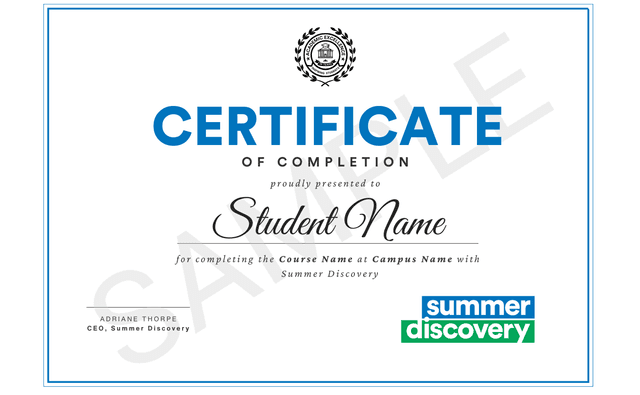
Summer Discovery Certificate of Completion
After successfully finishing this course, you will be awarded a certification completion for your accomplishment.
*This is a preview, not what you will receive
Yale University
Yale University
Yale University
Yale University