

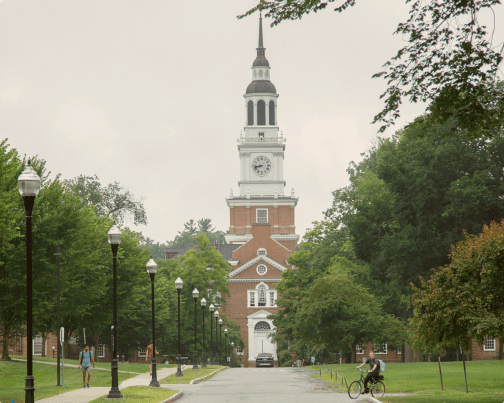

Enroll early for Summer 2027 to secure your preferred campus and program.
Develop your leadership style in Dartmouth’s signature two-week academy for high school students, combining campus study with a White Mountains backpacking expedition.
Rated 4.7 out of 5 for classroom experience by students who took this course in 2026.
Instructor:

Course Description
A group on a steep trail needs to choose a pace, respond to changing weather and look after its members. Leadership becomes a series of decisions with immediate consequences for other people.
Begin on Dartmouth’s campus with leadership theory, case analysis and reflection on how you respond to pressure and disagreement. Simulations, strengths assessments and peer feedback help you examine the role you tend to take in a team. The aim is to recognize how your choices affect the group and consider when another approach might serve it better.
Then take that work into a multi-day backpacking expedition through New Hampshire’s Presidential Range, with the goal of summiting six peaks. Students take turns leading, navigating and helping the group manage demanding conditions. Nights at the Appalachian Mountain Club’s Lakes of the Clouds and Mizpah Spring huts make shared responsibility part of the entire expedition. Group reflection connects experiences on the trail with your Leadership Blueprint and a short recorded Leadership Statement about the leader you want to become.
This two-week full-day residential academy for high school students is part of Dartmouth Precollege Summer Scholars in Hanover, New Hampshire. Developed and academically led by Dartmouth, it combines campus study with a demanding mountain expedition. Students build a clearer view of their leadership approach through academic work, reflection and responsibility for one another.
What You Will Do
• Analyze leadership choices through campus cases and simulations
• Use strengths assessments and feedback to examine your team role
• Take turns leading on a Presidential Range backpacking expedition
• Navigate steep terrain and respond to changing weather as a group
• Create a Leadership Blueprint informed by classroom and trail reflection
• Record a short video explaining your leadership philosophy and next steps
Learning Outcomes
By the end of the course, students will be able to:
• Explain how personal values and leadership theory inform a decision
• Adapt communication and leadership choices to a group’s needs and circumstances
• Use reflection and peer feedback to identify strengths and next steps
You’ll leave with a one-page Leadership Blueprint and recorded Leadership Statement that capture your leadership approach, areas for growth and next steps.
Why Leadership Skills Matter
A group can have a clear goal and still disagree about how to reach it. Listening carefully, explaining a decision and noticing who needs support help a team make progress. Case studies and shared challenges give students specific situations in which to examine those choices.
Reflection turns the experience into something they can use again. Comparing their intentions with feedback from others helps students recognize a strength or a habit they want to change. A personal leadership plan makes that observation concrete enough to try in a school project, community group or another situation that calls for shared responsibility.
Who Should Attend?
For students who have completed 9th, 10th, 11th or 12th grade.
This session is for students seeking a substantial physical challenge alongside academic leadership work. Students should be in good physical condition and ready for long, steep hiking days while carrying a pack. Expect to navigate with others, share responsibilities and reflect on decisions.
Students stay in two Appalachian Mountain Club huts reached on foot: Lakes of the Clouds and Mizpah Spring. Hut crews prepare and serve family-style dinner and breakfast. The program provides lunch, which students carry alongside their water and personal gear.
Lakes of the Clouds sits at about 5,050 feet, below Mount Monroe and about a mile from Mount Washington’s summit. It holds 90 guests in rooms of 6 to 15. Mizpah Spring sits at about 3,800 feet near the Crawford Path, between two 4,000-foot peaks, and holds 60 guests in rooms of 4 to 10.
Bunkrooms are coed and may be shared with other hikers. A program staff member stays in every bunkroom that houses students. Rooms have no heat, lights or electrical outlets. Students need a sleeping bag rated for cold nights and a headlamp. Pillows are not supplied; a small personal pillow is optional.
There are no showers. Mizpah has composting toilets and cold-water sinks. Students carry out everything they bring in, including trash and leftover food. Cell service is limited, and weather above treeline can become cold, windy and wet even in July. Students hike between the huts carrying everything they need.
93% Would Recommend The Dartmouth Leadership Institute
Based on students surveyed after attending the 2025 Dartmouth Leadership Institute.
Your Summer at Dartmouth
The Leadership Institute brings together three things that are difficult to find in one precollege program: Dartmouth-designed academic study, leadership practice with faculty and expert instructors, and place-based learning at the Appalachian Mountain Club’s Lakes of the Clouds and Mizpah Spring huts. The mountain huts and White Mountains are not a field trip added to the academy; they are where students test what they have learned about judgment, service, resilience, and responsibility.
That movement from classroom to mountain challenge makes the Institute the signature experience in the Dartmouth Precollege Summer Scholars portfolio. Fully developed and run by Dartmouth, it offers students an intensive encounter with both Dartmouth’s intellectual culture and its longstanding connection to the outdoors.
After successfully finishing this course, you will be awarded a certification completion for your accomplishment.
*This is a preview, not what you will receive