
More reasons to enroll early: Save $250 on tuition + 50% off your deposit. Enroll by Oct 31.
Propose a medical solution in this two-week Dartmouth biomedical engineering academy for high school students.
Course Description
A medical technology has to work for a body and for the person who depends on it. Investigate how engineers help clinicians see inside the body, support damaged tissue, and deliver treatment where it is needed.
Case studies, hands-on activities, and team design challenges introduce the connections between engineering, medicine, and human biology. Explore biomaterials, tissue engineering, and wound healing, then examine drug delivery, medical imaging, biomechanics, and biosensors. Questions about movement, measurement, and repair give you different ways to see how a technology addresses a clinical need. The course also examines how data, computation, and artificial intelligence are changing biomedical research and patient care.
Research-lab visits and conversations with engineers, clinicians, and graduate students connect those topics with the work people do in the field. For the culminating team project, propose a solution to a real clinical problem. Consider the scientific and engineering reasoning behind the approach alongside patient safety, regulation, and ethical questions. Developing the proposal asks you to connect a patient’s need with a defensible design, rather than assume that a technically promising idea is automatically ready for clinical use.
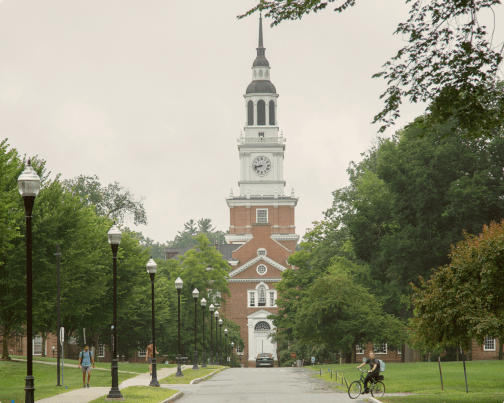
This two-week full-day academy for high school students is part of Dartmouth Precollege Summer Scholars in Hanover, New Hampshire. Beyond class, students connect focused academic work with campus life, growing independence, and clearer direction about what they may want to study or pursue next.
What Will You Do?
• Investigate how biomaterials and tissue engineering can support healing
• Examine drug delivery, medical imaging, and biosensor technologies
• Apply engineering and biomechanics concepts in hands-on activities and design challenges
• Explore how data and artificial intelligence are used in medicine
• Visit research labs and discuss the field with engineers, clinicians, and graduate students
• Develop a team proposal for a solution to a real clinical problem
Learning Outcomes
By the end of the course, students will be able to:
• Explain how biomedical technologies address needs in diagnosis, treatment, monitoring, and repair
• Apply engineering and biological concepts to propose a solution to a clinical problem
• Evaluate a medical design’s patient-safety, regulatory, and ethical considerations
You’ll leave with your team’s clinical-design proposal and a clearer sense of whether biomedical engineering, medicine, or related research merits deeper exploration.
Why Biomedical Engineering Skills Matter
A clinical need can be understood in several ways: through the body’s biology, the patient’s experience, and the engineering limits of a proposed solution. Bringing those perspectives together helps students define a problem before deciding how to address it. A design has to respond to the need that prompted it.
Biomedical engineering also makes the consequences of a technical choice visible. A material, sensor, or delivery method must be considered alongside safety, regulation, and ethics. Explaining those tradeoffs gives students practice evaluating an idea with evidence and communicating why an approach may be useful, where it is limited, and what still needs investigation.
Who Should Attend?
For students who have completed 9th, 10th, 11th, or 12th grade.
If you are interested in how technology can address a medical problem, this academy connects that question with biology and engineering. Interests in medicine, design, computing, human movement, or scientific research can all lead into the work. You’ll examine case studies, participate in hands-on activities, and collaborate on a clinical-design proposal. Students should be ready to explain their choices and consider a solution’s effects on patients alongside its technical potential. A school transcript and short-answer questions are required with the program application.
After successfully finishing this course, you will be awarded a certification completion for your accomplishment.
*This is a preview, not what you will receive