

More reasons to enroll early: Save $250 on tuition + 50% off your deposit. Enroll by Oct 31.
Develop evidence-based decarbonization strategies in this two-week Dartmouth academy for high school students.
Rated 4.9 out of 5 for classroom experience by students who took this course in 2026.

Course Description
A promising energy technology is only part of a climate solution. Put it alongside cost, policy, and the people who would use it, then see whether the plan holds up.
In this course you will calculate personal and community carbon footprints, interpret emissions data, and compare energy mixes, costs, and storage options. Case studies and team projects connect climate science and engineering with economics, philosophy, medicine, and public policy. Air quality and environmental justice bring the effects on people into the discussion.
In a carbon-tax versus cap-and-trade simulation, you’ll negotiate from the perspectives of governments, businesses, citizens, and nongovernmental organizations. Visiting scientists and sustainability professionals, plus a visit to Dartmouth’s Bone Lab, add perspectives from environmental anthropology, medicine, ecology, agriculture, and climate science.
Your final project proposes a realistic decarbonization plan for a community or system you know. Address emissions, feasibility, equity, infrastructure, policy, cost, and human behavior, then present the evidence behind your choices.
This two-week full-day academy for high school students is part of Dartmouth Precollege Summer Scholars in Hanover, New Hampshire. The program is developed and academically led by Dartmouth. Students focus on one intensive academy for the full program. Residential and commuter options are available.
What You Will Do
• Calculate personal and community carbon footprints
• Compare energy mixes, storage options, costs, and emissions
• Analyze climate-health and environmental-justice cases
• Negotiate in a carbon-tax versus cap-and-trade simulation
• Explore scientific perspectives through speakers and Dartmouth’s Bone Lab
• Design and present a realistic decarbonization strategy
Learning Outcomes
By the end of the course, students will be able to:
• Interpret environmental evidence to explain sources of carbon emissions
• Evaluate energy and policy choices using scientific, economic, and ethical reasoning
• Support a decarbonization strategy with evidence about feasibility and effects on people
You’ll leave with your sustainability proposal and a certificate of completion.
Why Clean Energy Skills Matter
Clean-energy decisions sit at the intersection of technology, evidence, cost, ethics, and public policy. Students learn that comparing energy sources requires more than naming what is renewable. They must examine emissions, infrastructure, environmental effects, feasibility, and who bears the benefits or costs.
Carbon-footprint calculations, data analysis, debate, and strategy work develop quantitative reasoning and systems thinking. These skills matter in engineering, environmental science, economics, geography, medicine, public health, law, and policy wherever communities must make defensible choices about climate and energy.
Who Should Attend?
For students who have completed 9th, 10th, 11th, or 12th grade.
You might come to climate questions through engineering, economics, ethics, or a concern for your own community. This academy brings those interests together around possible solutions. It suits you if you enjoy looking beyond the first answer and weighing what a change would mean for different people. Calculations, data analysis, policy debate, and a collaborative decarbonization project are part of the work.
Recommended by 9 out of 10 Students
Based on students surveyed in the Dartmouth Precollege Summer Scholars program (2026)
Your Summer at Dartmouth
Dartmouth Precollege Summer Scholars gives high school students a concentrated introduction to college-level learning in Hanover, New Hampshire. The program is developed and academically led by Dartmouth. Students explore current ideas through discussion, projects, and sustained work that helps them test an academic interest in depth.
Residential students live in Dartmouth residence halls, eat at 53 Commons, and can join workshops and counselor-supported evening and weekend activities. Time in Hanover and the Upper Valley adds a distinctive New England setting, while the broader experience helps students build independence and clarify what they may want to study next.
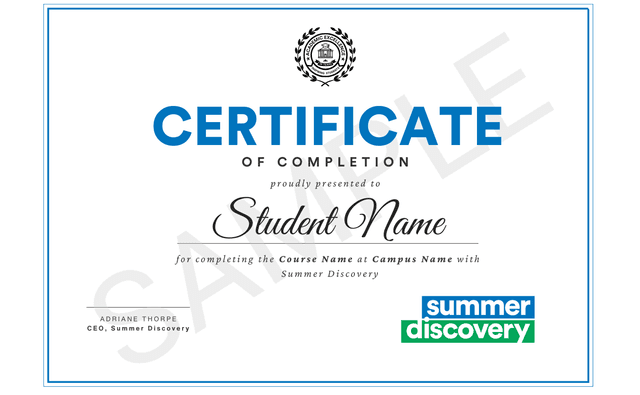
Summer Discovery Certificate of Completion
After successfully finishing this course, you will be awarded a certification completion for your accomplishment.
*This is a preview, not what you will receive
Dartmouth
Dartmouth
Dartmouth
Dartmouth