
More reasons to enroll early: Save $250 on tuition + 50% off your deposit. Enroll by Oct 31.
Design a life-detection instrument in this two-week Dartmouth astrobiology academy for high school students.
Course Description
Choose a world to investigate, then decide what an instrument would need to detect there. A search for life starts with questions about temperature, radiation, geology, and the evidence that could support an answer.
Astrobiology brings astronomy, engineering, biology, chemistry, and geology into the same investigation. Learn from a NASA scientist about the conditions that make a planet habitable and how researchers choose where to look, within our solar system and around other stars. Examine the engineering solutions used to explore those environments, including high-orbit satellites and instruments designed to probe beneath a surface. Conversations with planetary scientists, engineers, and microbiologists show how different kinds of expertise contribute to the search.
For the culminating project, propose your own life-detection instrument within a given set of parameters. Use what you have learned about the target environment and the capabilities of spacecraft instruments to explain what your design could investigate. The challenge asks you to connect a scientific question with an engineering approach and consider the limits of the evidence it might produce.
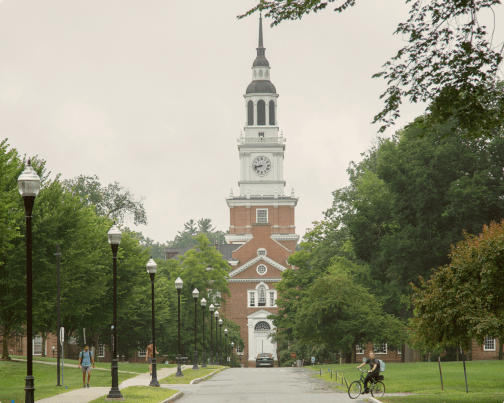
This two-week full-day academy for high school students is part of Dartmouth Precollege Summer Scholars in Hanover, New Hampshire. Beyond class, students connect focused academic work with campus life, growing independence, and clearer direction about what they may want to study or pursue next.
What Will You Do?
• Investigate the conditions that can make a planet habitable
• Compare possible places to search for life within and beyond our solar system
• Examine satellites and instruments used to study planetary environments
• Discuss research with planetary scientists, engineers, and microbiologists
• Evaluate the challenges of searching in atmospheres, surfaces, and subsurfaces
• Propose a life-detection instrument within a given set of parameters
Learning Outcomes
By the end of the course, students will be able to:
• Explain how temperature, radiation, and geology affect planetary habitability
• Compare spacecraft instruments and the evidence they can collect in different environments
• Propose a life-detection instrument that responds to a scientific question and design constraints
You’ll leave with your instrument proposal and a clearer sense of how astronomy, engineering, and the life sciences could connect to further study.
Why Astrobiology Skills Matter
A search for life requires a precise question and evidence capable of answering it. Comparing planetary environments helps students connect physical conditions with a scientific explanation. Examining an instrument adds another test: what can it measure, and what would that measurement actually establish?
Designing a proposal makes those connections practical. Students have to weigh a target’s conditions against an instrument’s capabilities and explain the reasoning behind their choices. Working across several disciplines also shows why a useful answer may depend on combining perspectives, rather than treating a scientific or engineering problem in isolation.
Who Should Attend?
For students who have completed 9th, 10th, 11th, or 12th grade.
If you wonder where life might exist beyond Earth, this academy gives you a way to investigate that question through science and engineering. Interests in astronomy, biology, chemistry, geology, or spacecraft can all provide a starting point. You’ll examine planetary conditions, discuss the work of researchers, and develop an instrument proposal within specified constraints. Students should be ready to connect ideas across subjects and explain why a design suits the question it is meant to answer. A school transcript and short-answer questions are required with the program application.
After successfully finishing this course, you will be awarded a certification completion for your accomplishment.
*This is a preview, not what you will receive