
More reasons to enroll early: Save $250 on tuition + 50% off your deposit. Enroll by Oct 31.
Develop and deliver a persuasive speech in this 3-week public-speaking program for high school students on UT Austin’s campus.
Rated 4.6 out of 5 for course experience by students surveyed across the broader program in 2026.
Instructor:

Course Description
A message can change when the speaker changes a pause, a gesture, or a single word. Try the choices that help an audience hear your argument and care about it.
In this course you will begin with what you care about and a short introduction. Posture, eye contact, vocal tone, pacing, and purposeful movement show how delivery shapes an audience’s response. Personal narratives add specific detail and emotional connection.
Build persuasive content through problems, stakes, claims, warrants, evidence, and impact. Mini-debates and challenge speeches introduce ethos, pathos, and logos: credibility, emotion, and reasoning. Crossfire questions and impromptu prompts give you practice responding and recovering when you cannot plan every word.
Adapt the same idea for parents, teachers, voters, athletes, gamers, or younger students, then write a four-to-six-minute persuasive speech. A hook, problem, argument, solution, call to action, and memorable closing give it shape. Peer feedback, rehearsal, and dress rehearsals help you refine the work before the final showcase.
This three-week course for high school students takes place at UT Austin in Austin, Texas. The course is available to residential and commuter students. The program is developed by the University of Texas at Austin and offered in partnership with Summer Discovery.
What You Will Do
• Deliver short speeches focused on presence, tone, pacing, and movement
• Build personal narratives with vivid detail and a clear takeaway
• Support persuasive claims with warrants, evidence, and impact
• Practice ethos, pathos, logos, mini-debates, and crossfire responses
• Adapt one message for audiences with different priorities
• Write, rehearse, and perform a four-to-six-minute persuasive speech
Learning Outcomes
By the end of the course, students will be able to:
• Build a persuasive argument using claims, evidence, reasoning, and a call to action
• Adapt stories, language, and delivery for different audiences
• Use purposeful vocal and physical choices to deliver and defend an argument
You’ll leave with your completed persuasive speech and a certificate of completion.
Students receive a University of Texas branded certificate of completion at the end of the program.
Why Persuasive Speaking Skills Matter
Persuasive speaking requires more than confidence. A speaker must define a claim, support it with credible evidence, anticipate objections, and shape the message for a particular audience. Storytelling and emotional appeal can make an argument memorable, but they work best when the reasoning remains clear.
Repeated short speeches help students notice how posture, pacing, tone, and word choice affect credibility. Peer critique teaches them to give useful feedback and revise deliberately. These skills strengthen classroom presentations, interviews, leadership, advocacy, and collaborative discussion. They also help students communicate under pressure without confusing volume or certainty with a well-supported case.
Who Should Attend?
For students who have completed 9th, 10th, 11th, or 12th grade.
You don’t need to arrive as a confident performer. An interest in a story, an issue, or an idea you want others to understand is a useful beginning. Frequent speaking, trying different deliveries, unexpected questions, peer feedback, and several rounds of revision are central to the course.
Your Summer at University of Texas at Austin
Studying on UT Austin’s Forty Acres campus gives high-school students a substantive introduction to academic life in Austin, Texas. Courses draw from popular undergraduate fields and Austin specialties. Full-day academies offer concentrated study, while classes across the program take place in campus classrooms and laboratories and may include guest speakers and fieldwork around Austin.
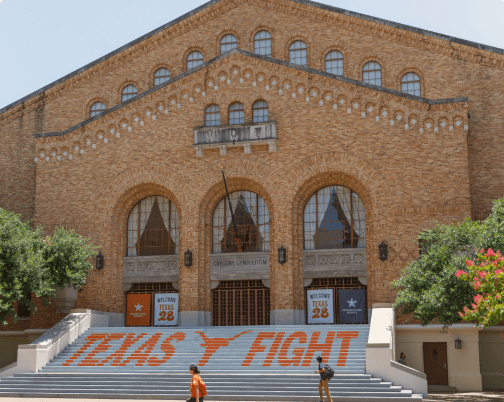
The experience extends beyond class for both residential and commuting students. Residential students live in Jester Hall, eat at J2, a popular campus dining hall, and take part in activities that may range from a star party at PMA to time at Gregory Gym, Zilker Park, South Congress, or an Austin FC match. Students gain independence, meet peers, and leave with a clearer view of college life, possible directions for future study, and what it can feel like to be a Longhorn.
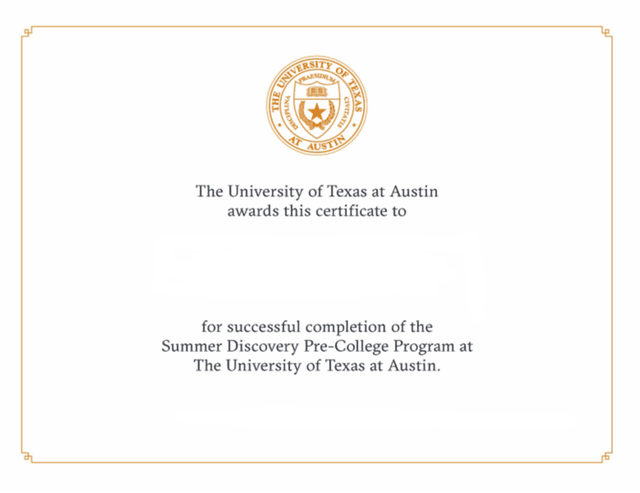
Summer Discovery Certificate of Completion
After successfully finishing this course, you will be awarded a certification completion for your accomplishment.
*This is a preview, not what you will receive