
More reasons to enroll early: Save $250 on tuition + 50% off your deposit. Enroll by Oct 31.
Build an original AI project for social impact in this two-week course for high school students on the University of Michigan campus.
Course Description
Start with an issue you care about and a blank page. Use AI to build something that could help the people you want to reach.
In this course you will try AI chat and coding tools, including ChatGPT or Claude, Lovable, and Cursor, in guided workshops. Vibe coding turns plain-language instructions into product features. Prompt, test, and revise as you learn how large language models generate responses and agents carry out connected tasks. Retrieval-augmented generation supplies relevant information; context engineering determines what information a system needs.
In the second half, build your own social-impact project, perhaps in health, mental health, financial inclusion, engineering, sustainability, or education. Define its users and impact measures, test the concept, and refine the product. Assess market fit, then pitch work you can continue developing for competitions, research fairs, or a college portfolio. Each revision brings you back to a practical question: is this useful to the people it is meant to help?
This two-week Summer Discovery course for high school students takes place on the University of Michigan campus in Ann Arbor, Michigan. Residential and commuter options are available.
What You Will Do
• Try AI chat and coding tools through guided workshops
• Examine how large language models, AI agents, and retrieval tools work
• Use prompting, context engineering, and vibe coding to build product features
• Define a social problem, target users, and measurable impact
• Test an individualized AI product and assess its market fit
• Pitch the finished project for feedback and future opportunities
Learning Outcomes
By the end of the course, students will be able to:
• Explain how models, agents, retrieval, and context affect an AI product
• Use prompting and vibe coding to build, test, and improve product features
• Evaluate a product against user needs, impact measures, and market fit
You’ll leave with your original AI product, project pitch, and a certificate of completion.
Why AI Product Development Skills Matter
Building with AI requires more than entering a prompt. Students need to define a problem clearly, choose relevant information, test outputs, notice where a system fails, and improve it through iteration. Those habits strengthen reasoning, communication, and product decision-making.
A social-impact project adds another layer: the product must serve real users and produce evidence of value. Defining an audience, measuring impact, and evaluating market fit help students connect technical choices to human needs. The same skills support research, entrepreneurship, design, and future study across many fields.
Who Should Attend?
For students who have completed 9th, 10th, 11th, or 12th grade.
If you have an idea for something useful but haven’t known how to build it, this course gives you tools to try. An interest in technology, design, entrepreneurship, or a social issue can be your starting point. No programming or computer science background is required.
You’ll test new tools, revise your ideas, consider users’ needs, and pitch an individual project. There’s room to explore whether AI or product development is something you want to pursue further.
Recommended by More Than 9 out of 10 Students
Based on students surveyed in Summer Discovery’s 2026 program at the University of Michigan.
Your Summer at University of Michigan
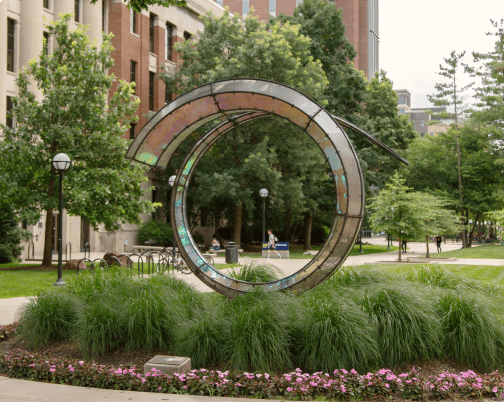
Programs on the University of Michigan campus give high-school students the experience of exploring an academic interest in Ann Arbor, a college town where campus and community life blend together. Tree-lined streets, downtown bookstores and cafés, the Nichols Arboretum, and trails near the Huron River create different ways to experience the setting beyond class.
Students learn alongside peers, navigate a large and active campus, and gain independence through everyday choices in a new environment. The experience helps students understand what university life can feel like while giving them space to deepen an interest without having every next step decided. For families, the program offers a meaningful combination of academic depth, community, personal growth, and clearer direction about what a student may want to study or pursue next.
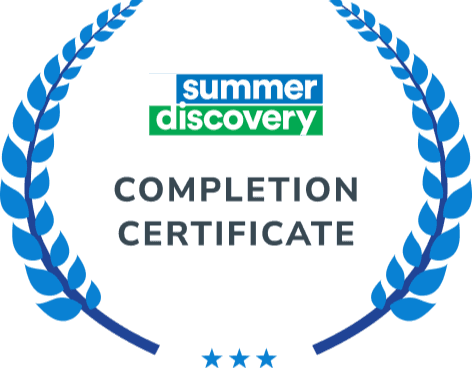
After successfully finishing this course, you will be awarded a certification completion for your accomplishment.
*This is a preview, not what you will receive