
More reasons to enroll early: Save $250 on tuition + 50% off your deposit. Enroll by Oct 31.
Create and break ciphers, then investigate an encryption system in this 3-week program for middle school students at UCLA.

Course Description
Hide a message in plain sight, then look for the pattern that gives it away. A clever cipher is an invitation to a determined codebreaker.
In this course your student will build cipher wheels and exchange encrypted messages with a partner. They’ll try different cipher systems to disguise a message. Counting how often letters appear can reveal a weakness. Modular arithmetic uses remainders to reveal patterns. Matrices, prime factorization, number theory, and how computers represent information add more ways to investigate the puzzles.
Historical cases, the historic Enigma code machine, and modern public-key ideas show how codebreaking affected events and why security changes as technology advances. Students then choose their own challenge: design an original cryptographic system or investigate how to break one. They’ll document the key, method, mathematical reasoning, and test results. Presenting the work means explaining what holds up, what fails, and why.
This three-week course for middle school students is part of Summer Discovery’s Institute for the Gifted program on UCLA’s campus in Los Angeles, California. Residential and commuter options are available.
What You Will Do
• Build cipher wheels and exchange secret messages
• Encrypt and decode Caesar and substitution ciphers
• Break simple ciphers using letter-frequency patterns
• Test different cipher systems and look for weaknesses
• Investigate the Enigma code machine, public-key encryption, and historical codebreaking
• Present your own cipher or codebreaking investigation
Learning Outcomes
By the end of the course, students will be able to:
• Explain how classical and modern encryption ideas protect information
• Use mathematical patterns and letter frequencies to encode or break messages
• Evaluate a cipher’s strengths and weaknesses using test evidence
You’ll leave with your encrypted work, documented codebreaking strategies, a cipher or cryptanalysis project and a certificate of completion.
Why Cryptography Skills Matter
A cipher needs rules precise enough for someone else to follow. Building one makes mathematical patterns useful; trying to break it shows why a convincing idea still needs testing. Letter frequencies, repeating alphabets, and prime numbers each offer a different way to reason about a message.
That combination of precision and skepticism helps students look more closely at how information is protected. They practice documenting a method so another person can check it and revising an explanation when a pattern does not fit.
Who Should Attend?
For students who have completed 6th, 7th, or 8th grade.
Secret messages give puzzle-lovers a reason to dig into mathematics, history, and computers. This course suits students who keep looking for a pattern and want to know why a solution works. Your student will calculate carefully, tackle codebreaking challenges with classmates, and improve a design after others test it.
No prior coding or advanced mathematics experience is required, though comfort with basic algebra is helpful.
Institute for the Gifted eligibility requirements apply; see the program FAQ.
Your Summer at UCLA
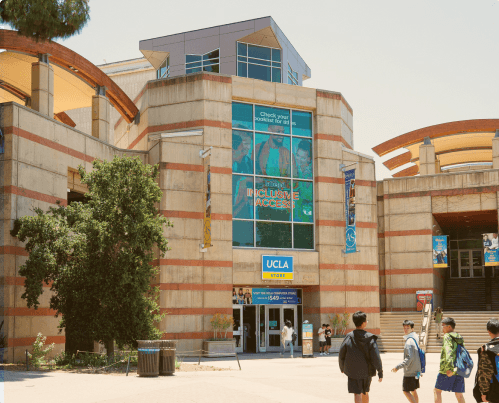
UCLA gives middle-school students an energetic place to learn, have fun, and experience campus life in Los Angeles. The setting brings together science, technology, creativity, entertainment, and culture, helping new subjects feel connected to a wider world of ideas.
The program combines hands-on academics with friendships, campus activities, clear routines, and support as students become comfortable in a large university environment. Students can try new challenges, share interests with peers, and build confidence through participation without needing to decide where those interests will lead. For families, UCLA offers a structured middle-school experience that balances substantive learning with fun, community, and age-appropriate independence. Students leave with new memories and a clearer sense of what they may want to explore next.
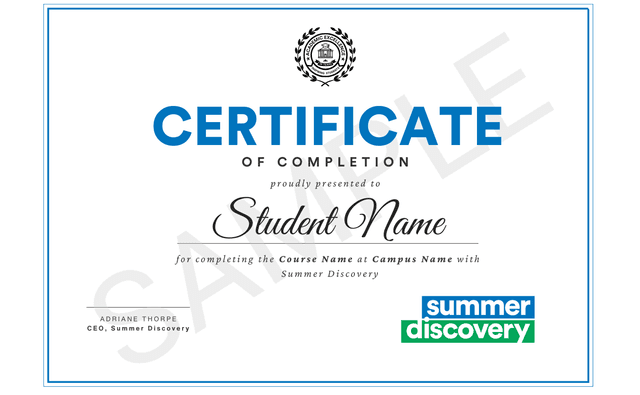
Summer Discovery Certificate of Completion
After successfully finishing this course, you will be awarded a certification completion for your accomplishment.
*This is a preview, not what you will receive