
More reasons to enroll early: Save $250 on tuition + 50% off your deposit. Enroll by Oct 31.
Investigate real data with Python in this 3-week Institute for the Gifted course for middle school students on UCLA’s campus.
Rated 4.3 out of 5 for classroom experience by students who took this course in 2026.


Course Description
Put a hunch to the test with real data. The numbers may tell a different story.
In this course your student will turn questions into investigations with Python and Pandas, a tool for working with data. They’ll learn Python syntax and use Pandas DataFrames, tables that code can work with, to explore messy datasets. Removing missing values and selecting columns brings the evidence into focus. Then comes a choice: which graph makes the pattern clear? They’ll try charts, labels, and formats to explain what they see.
A convincing graph still needs a careful reader. Students explore correlation versus causation and introductory linear regression, looking at connections without assuming one thing causes another. For their own investigation, they’ll choose a dataset and a question. Their Jupyter notebook combines code, charts, and written conclusions in one document. Sharing it lets them make a case for their findings and explain where the evidence stops.
This three-week course for middle school students is part of Summer Discovery’s Institute for the Gifted program on UCLA’s campus in Los Angeles, California. It is available to residential and commuter students.
What You Will Do
• Set up your coding tools and a Jupyter notebook
• Write Python expressions with variables and data types
• Investigate mean, median, mode, and outliers through card activities
• Import, clean, slice, and analyze datasets with Pandas
• Create bar graphs, pie charts, and histograms
• Present your findings in a documented Jupyter notebook
Learning Outcomes
By the end of the course, students will be able to:
• Use Python in a Jupyter notebook to answer questions about data
• Choose ways to clean, analyze, and graph a dataset with Pandas
• Explain what the data supports and what it cannot tell us
You’ll leave with your capstone Jupyter notebook and a certificate of completion.
Why Data Science Skills Matter
A pattern is a starting point, not proof. Working with Python and Pandas helps students ask whether a result holds across a dataset. Missing values or inconsistent formats can change an answer, making careful checking worthwhile.
Choosing a graph, scale, labels, and title is also a communication decision. Students consider what another person will understand and why correlation does not establish a cause. Those habits help them question the numbers and charts they encounter in school and everyday life.
Who Should Attend?
For students who have completed 6th, 7th, or 8th grade.
Puzzles, patterns, coding, and questions about evidence all have a place in data science. This course suits students who enjoy asking why and explaining what they discover. Your student will begin with foundational Python coding skills, then use them to investigate a question of their own. They’ll practice writing code and work through errors along the way.
View the eligibility requirements for the Institute for the Gifted on our FAQ page.
Your Summer at UCLA
UCLA gives middle-school students an energetic place to learn, have fun, and experience campus life in Los Angeles. The setting brings together science, technology, creativity, entertainment, and culture, helping new subjects feel connected to a wider world of ideas.
The program combines hands-on academics with friendships, campus activities, clear routines, and support as students become comfortable in a large university environment. Students can try new challenges, share interests with peers, and build confidence through participation without needing to decide where those interests will lead. For families, UCLA offers a structured middle-school experience that balances substantive learning with fun, community, and age-appropriate independence. Students leave with new memories and a clearer sense of what they may want to explore next.
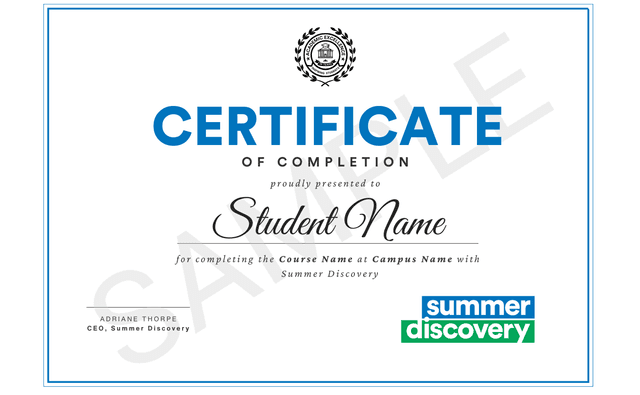
Summer Discovery Certificate of Completion
After successfully finishing this course, you will be awarded a certification of completion for your accomplishment.
*This is a preview, not what you will receive