
More reasons to enroll early: Save $250 on tuition + 50% off your deposit. Enroll by Oct 31.
Build and test flight designs in this two-week aerospace engineering academy for high school students on UC Berkeley’s campus.
Course Description
A glider has to carry its payload and stay in flight. Change the balance or wing design, and the next test can tell a different story.
In this course you will connect the forces of flight with engineering choices you can build and test. Design a glider around a fixed payload, then compare distance and stability in a flight-test competition. Investigate rocket propulsion and orbits, and program a basic drone or microcontroller-based demonstration to explore how sensors help control motion.
Materials bring another challenge: keeping a structure light while making it strong enough for the job. A stress test puts those choices under pressure. Your team then brings aerodynamics, propulsion, structures, and controls into a rover or lander concept. Build, test, and refine the design with instructor feedback before explaining it in a final pitch. The process offers a concrete way to explore engineering through decisions and evidence.
This two-week full-day Summer Discovery academy for high school students takes place on UC Berkeley’s campus in Berkeley, California. Students focus on one academy for the full program. Residential and commuter options are available.
What You Will Do
• Build a glider around a fixed payload
• Compete in flight tests measuring distance and stability
• Design and launch a model rocket
• Program a drone or microcontroller-based stabilization demonstration
• Test lightweight structures under stress
• Build and pitch a team rover or lander concept
Learning Outcomes
By the end of the course, students will be able to:
• Explain how aerodynamic forces and propulsion influence aerospace design
• Use test data to judge stability and strength-to-weight trade-offs
• Explain how structures and controls work together in an aerospace design
You’ll leave with your team’s capstone pitch and a certificate of completion.
Why Aerospace Engineering Skills Matter
Engineering choices affect one another. Adding strength can add weight; changing a glider’s balance can alter its flight. Testing those relationships helps you connect scientific ideas with the practical limits of a design.
A team concept also needs a clear explanation of why its parts work together. Using evidence to revise and defend a design develops reasoning that carries into later physics, mathematics, and engineering projects. The value is in understanding a decision, including what you would test next.
Who Should Attend?
For students who have completed 9th, 10th, 11th, or 12th grade.
Curious about how aircraft fly or spacecraft land? This academy lets you follow a design from an idea to a test, then decide what to change. Building a glider and developing a rover or lander concept with a team offer different ways to explore what draws you to engineering.
Your Summer at UC Berkeley
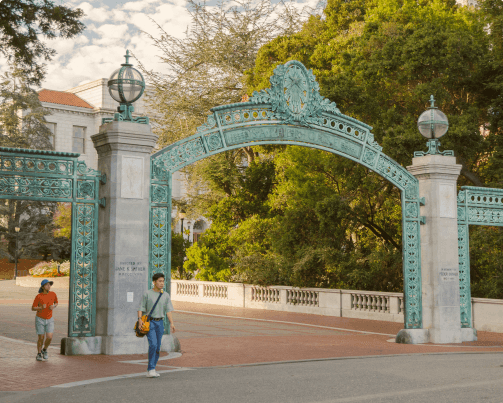
UC Berkeley gives high-school students the opportunity to pursue serious academic exploration in a campus environment shaped by scientific inquiry, new ideas, and an active connection to the wider Bay Area. The Berkeley Hills, distinctive architecture, and green spaces make the experience feel different from an ordinary school routine.
Students learn alongside peers, become more independent, and experience the pace and possibility of university life. The Bay Area context adds exposure to a region influenced by research, technology, entrepreneurship, culture, and public debate. For families, the value is not campus prestige alone. It is the combination of academic depth, community, and a student gaining clearer insight into the subjects, environments, and possible directions that genuinely motivate them.
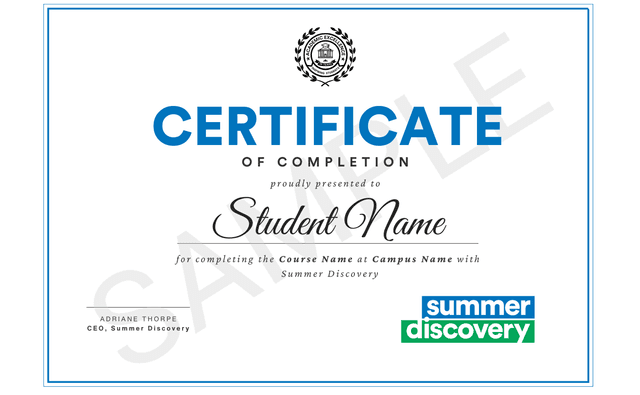
Summer Discovery Certificate of Completion
After successfully finishing this course, you will be awarded a certification completion for your accomplishment.
*This is a preview, not what you will receive