
More reasons to enroll early: Save $250 on tuition + 50% off your deposit. Enroll by Oct 31.
Analyze contracts and negotiate as a sports agent in this 2-week sports law program for high school students on Georgetown University’s campus.
Instructor:

Course Description
A contract can give an athlete an opportunity and create obligations that last beyond the game. Look at a sports deal from each side, then work through the rules that shape it.
In this course you will compare amateur, professional, and international sports and apply contract and tort law to sporting-event scenarios. NCAA eligibility, recruiting, and transfer-portal cases show how a decision can change what is allowed. Name, image, and likeness (NIL) agreements, pay-for-play questions, and Title IX protections against sex discrimination bring college athletics into focus.
Try negotiation, mediation, and arbitration through a sports-agent exercise. Collective bargaining shows what is at stake when labor talks stall; antitrust law and Major League Baseball’s antitrust exemption reveal how competition is regulated. You’ll brief a case and examine representation, marketability, and conflicts of interest alongside endorsement, licensing, sponsorship, copyright, and trademark issues. Gambling, doping, safety, and technology add ethical questions that a legal strategy must confront. The course concludes with a final exam.
This two-week course for high school students takes place at Georgetown University in Washington, D.C. The program is developed by Georgetown University and offered in partnership with Summer Discovery. Students may request an official Georgetown University transcript.
What You Will Do
• Apply contract and tort law to sports scenarios
• Evaluate NCAA recruiting, eligibility, and transfer-portal cases
• Examine athlete name, image, and likeness agreements and sex-equity requirements under Title IX
• Negotiate, mediate, and arbitrate in a sports-agent exercise
• Brief a case involving the business of sports
• Debate sports ethics around gambling, doping, safety, and technology
Learning Outcomes
By the end of the course, students will be able to:
• Explain how contracts, liability, labor, competition, and intellectual property shape sports decisions
• Apply relevant legal standards to college-athletics and sports-agent scenarios
• Compare negotiation, mediation, arbitration, and collective bargaining in sports disputes
You’ll leave with your case brief, legal scenario analyses and a certificate of completion.
Why Sports Law Skills Matter
Sports law asks students to read closely, identify competing interests, and explain how a rule applies to a specific set of facts. Contract review builds attention to obligations and risk. Case briefs require students to separate relevant evidence from background information and support a conclusion with clear reasoning.
Those habits matter when people negotiate, resolve disputes, evaluate policies, or make decisions that affect several stakeholders. Students also practice seeing an issue from the perspectives of athletes, teams, leagues, schools, agents, and sponsors. That combination of precise reading, evidence-based argument, and practical judgment supports stronger work in law, business, sports management, public policy, and everyday decision-making.
Who Should Attend?
For students who have completed 9th, 10th, 11th, or 12th grade.
Sports followers can explore the rules behind the headlines, while students drawn to law or business can see how a major industry works. If you enjoy weighing competing interests and making a case from evidence, there is plenty to consider here. Reading fact patterns, taking notes, small-group discussion, and negotiation exercises lead toward a final exam.
Recommended by More Than 4 out of 5 Students
Based on students surveyed in 2026 about Summer Discovery High School programs at Georgetown University campus.
Your Summer at Georgetown University
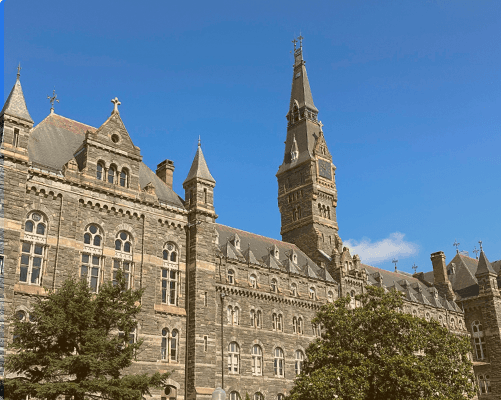
Studying on Georgetown University’s campus gives high-school students the opportunity to explore an academic interest while experiencing campus life in Washington, D.C. Its historic campus and surrounding neighborhood sit near embassies, institutions, and organizations that shape national and international conversations, giving the summer a distinctive sense of place.
Students learn alongside peers with similar interests, navigate a new environment, and gain independence through everyday choices and responsibilities. Time outside class helps students experience the broader rhythm of university life while considering what subjects, communities, and possible directions feel right for them. For families, the program offers a combination of substantive academic exploration, personal growth, and clearer insight into what a student may want to study or pursue next.
After successfully finishing this course, you will be awarded a certification completion for your accomplishment.
*This is a preview, not what you will receive