
More reasons to enroll early: Save $250 on tuition + 50% off your deposit. Enroll by Oct 31.
Investigate ocean life and propose a conservation solution in this 3-week program for elementary school students at Fairfield University.
Course Description
Tiny plankton and giant marine mammals share a connected ocean. A change in one place can reach much further than it first appears.
In this course your child will explore life from coral reefs to the ocean floor. They’ll test density, model the water cycle, and investigate ocean chemistry. Food webs and organism research show how marine life has adapted over time. Temperature, depth, pollution, fishing, and habitat loss raise questions about what puts it at risk.
Your child will choose a marine issue and propose a way to help animals, plants, and local people. They’ll consider the money, supplies, or public support it would need, then make their case in a mock election. Protecting ocean life becomes a problem they can think through and explain.
This three-week course for elementary school students is part of Summer Discovery’s Institute for the Gifted program on Fairfield University’s campus. The course is available to commuter students.
What You Will Do
• Research an ocean organism and share its adaptations
• Trace connections through marine food webs
• Test density and model the water cycle
• Investigate how ocean conditions and human activity affect marine life
• Plan a conservation solution and the support it needs
• Make the case for your proposal in a mock election
Learning Outcomes
By the end of the course, students will be able to:
• Explain how ocean conditions and food webs affect marine life
• Use experiments and research to explain changes in an ocean system
• Explain how a conservation choice can affect people and the environment
You’ll leave with your marine-science investigations, organism research, conservation proposal, and a certificate of completion.
Why Marine Biology Skills Matter
An ocean food web shows how living things depend on one another. Experiments connect those relationships with water chemistry, temperature, and habitats, helping children explain why a change can affect more than one animal or plant.
Planning a conservation proposal adds another question: what would help both wildlife and local people? Children practice using evidence, considering what an idea would need, and explaining why it could work.
Who Should Attend?
For students who have completed 4th or 5th grade.
Ocean animals, coral reefs, or protecting a favorite stretch of coast can all be a way into this course. It suits children who enjoy experiments and research and want to understand what happens beneath the surface. Your child will explore ideas with classmates and build a conservation proposal, weighing what could help wildlife alongside what local people need.
Institute for the Gifted eligibility requirements apply; see the program FAQ.
Your Summer at Fairfield University
Fairfield gives elementary students a fun and welcoming place to explore marine biology in a coastal Connecticut town along Long Island Sound. Even when the day’s work stays on campus, the surrounding shoreline makes questions about ocean life, habitats, conservation, and human impact feel close and real. The setting adds a sense of discovery without requiring the course to promise unconfirmed coastal excursions.
The commuter-only program combines hands-on learning with friendships, clear routines, and support throughout the program day. Students can investigate living systems, share observations, and build confidence before returning home each afternoon. For families, Fairfield offers an age-appropriate balance of science, creativity, fun, and structure. Students get the satisfaction of seeing how classroom questions connect to the natural world just beyond campus.
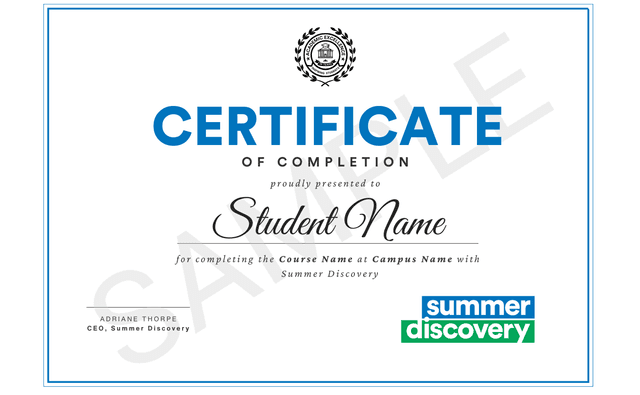
Summer Discovery Certificate of Completion
After successfully finishing this course, you will be awarded a certification of completion for your accomplishment.
*This is a preview, not what you will receive