

More reasons to enroll early: Save $250 on tuition + 50% off your deposit. Enroll by Oct 31.
Extract strawberry DNA and invent a plant in this 3-week program for elementary school students at Fairfield University.
Course Description
A seed sprouts, colored water climbs a celery stem, and strawberry DNA becomes visible. There’s plenty to discover in things that grow.
In this course your child will plant seeds, journal their growth, and open a bean to find its baby plant, protective coat, and stored food. Pollination and grouping plants by shared features reveal more about plant families.
They’ll extract strawberry DNA and build a twisted-ladder model with matching letter pairs. Comparing inherited and learned traits helps explain what gets passed from parents to offspring.
Then imagination joins the science. Your child will invent a plant with its own DNA pattern, traits, habitat, and helpful mutation: a change that helps it survive. They’ll develop a model, practice explaining their choices, and share it at a Plant Genetics Showcase.
This three-week course for elementary school students is part of Summer Discovery’s Institute for the Gifted program on Fairfield University’s campus in Fairfield, Connecticut. The course is available to commuter students.
What You Will Do
• Plant seeds and track growth in a journal
• Watch colored water travel through a celery stem
• Pull visible strands of DNA from strawberries
• Build a DNA model pairing A–T and C–G
• Open a bean to discover its hidden parts
• Invent a plant with traits that suit its habitat
Learning Outcomes
By the end of the course, students will be able to:
• Explain how DNA helps pass traits from one plant to the next
• Describe how a change in plant traits can help it survive
• Use drawings and observations to explain how a plant grows
You’ll leave with your plant journal, DNA model, original plant model, and a certificate of completion.
Why Plant Genetics Skills Matter
Watching a seed grow gives children something real to notice, compare, and explain. A journal helps them look back at changes rather than rely on memory, while a model makes tiny DNA patterns easier to picture.
Inventing a plant connects imagination with a reason: its traits need to help it live somewhere. That habit of asking “why would this work?” can carry into the next science lesson or a discovery in the garden.
Who Should Attend?
For students who have completed 1st, 2nd, or 3rd grade.
For children who notice a new leaf, enjoy gardening, or wonder how living things grow, this course makes room for a closer look. Your child can explore through experiments, drawings, and models, then let imagination take over as they invent a plant of their own. They’ll develop that idea over several days and share what they discover.
Institute for the Gifted eligibility requirements apply; see the program FAQ.
Your Summer at Fairfield University
Fairfield gives elementary students a fun and welcoming first taste of campus life in a coastal Connecticut town along Long Island Sound. The day includes hands-on classes, outdoor courtyard time, shared meals, and opportunities to make friends in a setting that feels active without feeling overwhelming.
The commuter-only Institute for the Gifted has operated at Fairfield for more than two decades. Students try new challenges and build confidence within a clear, structured program day. For families, Fairfield offers an age-appropriate combination of learning, creativity, friendship, routine, and support. Students get the fun of a summer program and the satisfaction of discovering what they can make, solve, and explore next.
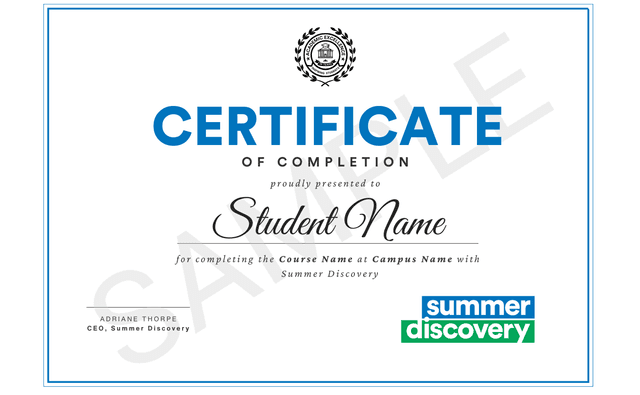
Summer Discovery Certificate of Completion
After successfully finishing this course, you will be awarded a certification completion for your accomplishment.
*This is a preview, not what you will receive