



More reasons to enroll early: Save $250 on tuition + 50% off your deposit. Enroll by Oct 31.
Build and pitch a business concept in this three-week entrepreneurship course for elementary and middle school students on Cornell University’s campus.
Instructor:

Course Description
An idea becomes a stronger business concept when you can explain whose problem it solves and why someone would choose it. Test that reasoning before you build a pitch.
You’ll identify an unmet need, investigate possible customers, and use a Lean Business Model Canvas to organize your idea. Market research and competitive analysis help you compare the alternatives people already have. Examine what makes a proposed solution useful and how branding and a marketing message can communicate that value. Class discussions, workshops, and feedback give you opportunities to question an assumption and revise the concept.
Financial exercises connect the idea with the costs of making it work. Compare fixed and variable costs, consider pricing, and calculate a break-even point. Bring the research and decisions together in a pitch presentation. Explain the problem, customer, solution, competitive advantage, and financial reasoning, then respond to questions. Your final work includes the business concept, canvas, research artifacts, and pitch. It gives you something concrete to examine as you discover which parts of creating a venture interest you.
This three-week course for elementary and middle school students is part of Summer Discovery’s Institute for the Gifted program on Cornell University’s campus in Ithaca, New York. Beyond class, students connect academic exploration with campus life, new friendships, growing independence, and curiosity they can keep exploring.

What Will You Do?
• Identify a problem or unmet need and compare possible business opportunities
• Organize and test an idea with a Lean Business Model Canvas
• Research target customers and examine competing solutions
• Develop a value proposition, brand direction, and marketing message
• Explore costs, pricing, and break-even calculations for the concept
• Present a business pitch and respond to questions and feedback

Learning Outcomes
By the end of the course, students will be able to:
• Evaluate a business opportunity using customer and competitor research
• Connect a proposed solution with its value, costs, and pricing assumptions
• Present a business concept with evidence supporting its main decisions
You’ll leave with your business concept, Lean Business Model Canvas, research artifacts, and pitch presentation, with a clearer sense of what you want to explore next.

Why Entrepreneurship Skills Matter
Entrepreneurship gives students a reason to test an idea against someone else’s needs. Customer research can challenge an initial assumption, while competitive analysis asks them to explain why a different solution might be useful. A business concept becomes stronger when the reasoning is visible enough to question.
Cost and pricing exercises add another perspective: an appealing product still needs a plan for how it could work. Presenting the concept requires students to bring research, calculations, and communication together. Those habits support group projects, thoughtful decisions, and further exploration of business without asking young students to choose a career now.

Who Should Attend?
For students who have completed 5th, 6th, 7th, or 8th grade.
If you enjoy inventing ideas, noticing a problem, or asking why people choose a product, this course gives you a way to investigate. You’ll research customers, work with basic calculations, revise a business concept, and present it to others. Students should be willing to test an assumption and consider feedback from classmates. A laptop, Chromebook, or tablet is recommended for research, project artifacts, and the pitch deck. The focus is on developing and explaining an idea.
Institute for the Gifted eligibility requirements apply; see the program FAQ. A completed program application is required.
Entrepreneurship in Action
A venture begins with choices about the problem it will address, the people it will serve, and how a solution could work. An entrepreneur has to connect those choices with research, costs, and a clear explanation of value. Feedback can reveal a reason to change an idea before investing more effort in it.
Students try that process through a business concept, canvas, and pitch. They can continue exploring products, services, marketing, or the financial questions behind a venture. The work offers a starting point for examining how an idea responds to a need and what evidence would make its case stronger.
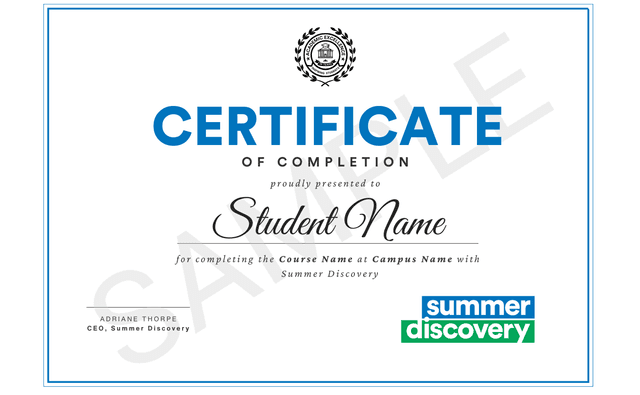
Summer Discovery Certificate of Completion
After successfully finishing this course, you will be awarded a certification completion for your accomplishment.
*This is a preview, not what you will receive