


More reasons to enroll early: Save $250 on tuition + 50% off your deposit. Enroll by Oct 31.
Build and explain a simulated portfolio in this three-week finance course for elementary and middle school students on Cornell University’s campus.
Rated 4.5 out of 5 for course experience by students surveyed across the broader program in 2026.
Instructor:

Course Description
A company’s familiar name might catch your attention. Deciding whether it belongs in a portfolio takes a closer look at its business, finances, and risks.
You’ll use imaginary funds to build a stock portfolio, choosing companies and industries that interest you. Stock screeners, company profiles, and industry research help you compare possible investments. Financial statements introduce clues such as revenue trends, margins, and debt. You’ll examine investment strategies, consider different attitudes toward risk, and revise your choices as you gather information. A tracking template records stock prices, portfolio value, and return on investment so you can explain what changed.
The course also connects investing to everyday money decisions. Budgeting activities, credit simulations, and compound-interest calculators show how spending, borrowing, saving, and time affect a financial plan. For your capstone, bring the research together in a portfolio presentation. Explain the companies you chose, how you divided the imaginary funds, what the results show, and which assumptions deserve another look. Questions from classmates give you practice supporting a recommendation with evidence while recognizing what remains uncertain.
This three-week course for elementary and middle school students is part of Summer Discovery’s Institute for the Gifted program on Cornell University’s campus in Ithaca, New York. Beyond class, students connect active academic exploration with campus life, new friendships, growing independence, and curiosity they can keep exploring.
What You Will Do
• Compare investment strategies and discuss how goals affect portfolio choices
• Research companies and industries using stock screeners and financial reports
• Build a simulated stock portfolio with imaginary funds
• Track prices, allocations, portfolio value, and return on investment
• Explore budgeting, credit, and compound interest through calculations and simulations
• Present your portfolio research, results, and investment reasoning to classmates
Learning Outcomes
By the end of the course, students will be able to:
• Compare investments using company research, financial information, and risk considerations
• Calculate and explain changes in a simulated portfolio’s value and returns
• Present an investment strategy with evidence supporting the choices and assumptions
You’ll leave with your simulated portfolio, tracking work, and presentation, along with financial questions and methods you can keep exploring.
Why Financial Analysis Skills Matter
Financial analysis asks students to connect a decision with its consequences. Reading a company’s results, calculating a return, and comparing risks make it harder to rely on a familiar name or an appealing story alone. Students learn to separate evidence from an assumption and explain what a calculation actually tells them.
Everyday money choices involve similar tradeoffs. A budget connects spending with available funds, while a compound-interest model shows how time changes an outcome. Working with imaginary money gives students room to test ideas and revise their thinking. The value comes from understanding the reasoning behind a choice.
Is This Course Right for You?
For students who have completed 5th, 6th, 7th, or 8th grade.
If you wonder how businesses earn money, why stock prices change, or how people choose investments, this course gives you a way to investigate. You’ll research companies, work through calculations, and explain choices to classmates. Be ready to compare sources, question an initial idea, and keep records as a simulated portfolio changes. The activities use imaginary funds, so students can explore financial decisions without making real investments.
Institute for the Gifted eligibility requirements apply; see the program FAQ. A completed program application is required.
Recommended by More Than 4 out of 5 Students
Based on students surveyed in Summer Discovery’s 2026 Cornell program.
Your Summer at Cornell
Cornell’s Ithaca setting gives elementary and middle school students an adventurous first experience of campus life, surrounded by Finger Lakes gorges, waterfalls, and a landscape shaped by research, agriculture, and invention. The setting makes learning feel different from an ordinary school day and gives students plenty to notice and explore.
The program combines active academics with friendships, campus activities, clear routines, and support as students become more comfortable in a new environment. Students can try challenging ideas, share interests with peers, and enjoy the fun of living and learning on a university campus. For families, Cornell offers a structured middle-school experience that balances learning and discovery with community, support, and growing independence.
Financial Analysis in Action
Company research can answer different questions for different people. An investor might compare profitability and debt before choosing a stock. A business owner might examine the same measures to understand operating decisions. A financial analyst organizes information so someone else can assess a choice and its risks.
Students encounter that work through their simulated portfolios and presentations. Outside the stock market, a household budget or a savings model also depends on clear assumptions, accurate calculations, and a purpose for the money. The course introduces several contexts for financial reasoning without asking students to choose a career or commit real funds.
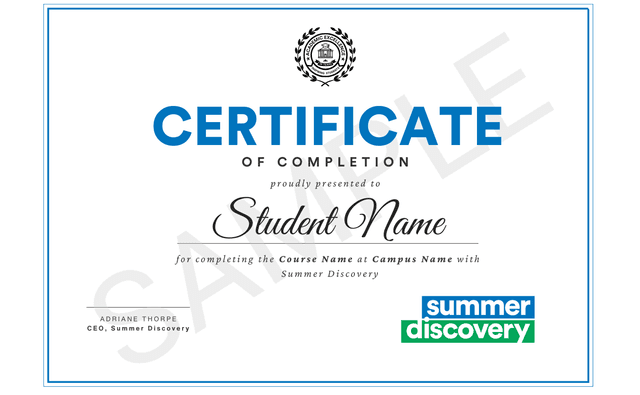
Summer Discovery Certificate of Completion
After successfully finishing this course, you will be awarded a certification of completion for your accomplishment.
*This is a preview, not what you will receive