
More reasons to enroll early: Save $250 on tuition + 50% off your deposit. Enroll by Oct 31.
Code a social-good project in this three-week AI course for elementary and middle school students on Cornell University’s campus.
Instructor:
Course Description
A computer needs examples and instructions before it can recognize a pattern. Build a chatbot, examine a dataset, and see how a model’s choices affect what it produces.
You’ll develop Python skills through guided notebooks in Google Colab, working with variables, loops, conditionals, and functions. Customize a chatbot, visualize data, and investigate how a decision-tree model can identify patterns in a sample healthcare dataset. Computer-vision activities introduce image classification and assistive technology. Discussions ask you to consider who a system helps, where its limitations matter, and how design choices can affect people differently.
For the collaborative capstone, apply machine learning to a question with a social purpose. The curriculum offers examples involving crop-yield prediction, movie recommendations, and disaster-relief resource allocation. With feedback from classmates and the instructor, develop a project, evaluate its performance, and revise the approach. A final showcase gives you a chance to explain the process and what the model can and cannot establish. The work combines coding with questions about evidence, responsibility, and the uses of AI.
This three-week course for elementary and middle school students is part of Summer Discovery’s Institute for the Gifted program on Cornell University’s campus in Ithaca, New York. Beyond class, students connect academic exploration with campus life, new friendships, growing independence, and curiosity they can keep exploring.

What Will You Do?
• Learn Python fundamentals through guided Google Colab notebooks
• Customize a chatbot and examine how language-processing systems work
• Visualize data and investigate patterns with a decision-tree model
• Explore image classification and assistive technology through computer vision
• Discuss the ethical implications and limitations of AI applications
• Develop, evaluate, and present a collaborative social-good capstone

Learning Outcomes
By the end of the course, students will be able to:
• Use Python programming concepts to develop a guided AI project
• Explain how data, model choices, and evaluation affect an AI system’s results
• Present an AI capstone’s purpose, methods, and limitations clearly
You’ll leave with your collaborative AI project and showcase presentation, with new questions about coding, data, and responsible technology to explore.

Why Artificial Intelligence Skills Matter
Coding makes an idea specific enough for a computer to carry out. A variable, a condition, or a loop has a visible effect on the result, giving students a reason to test and revise their instructions. Examining a model adds questions about the data it uses and the conclusions it supports.
The course also asks students to connect technical choices with people’s needs. Explaining a social-good project requires them to consider the purpose, limitations, and possible effects of a system. Those habits support careful problem solving, collaborative work, and further exploration of how technology can be used responsibly.

Who Should Attend?
For students who have completed 5th, 6th, 7th, or 8th grade.
If you’re curious about coding, AI, or how technology can help with a real question, this course gives you several ways to explore. The curriculum includes Python fundamentals and guided projects for students with different levels of coding experience. You’ll work through errors, examine examples, collaborate with classmates, and explain a model’s limits. Students should be ready to revise an approach and discuss ethical questions alongside the technical work, rather than treating an AI result as automatically correct.
Institute for the Gifted eligibility requirements apply; see the program FAQ. A completed program application is required.
Artificial Intelligence in Action
AI applications can recommend a movie, classify an image, or help examine information during an emergency. Each starts with a purpose, data, and a method for finding patterns. A useful system also needs evaluation: the people using it must understand what it does well and where a result may be unreliable.
Students encounter those questions through programming, computer vision, and a social-good capstone. They can continue exploring software, data science, assistive technology, or another area that interests them. The project offers a way to connect a technical idea with a need and explain the choices made along the way.
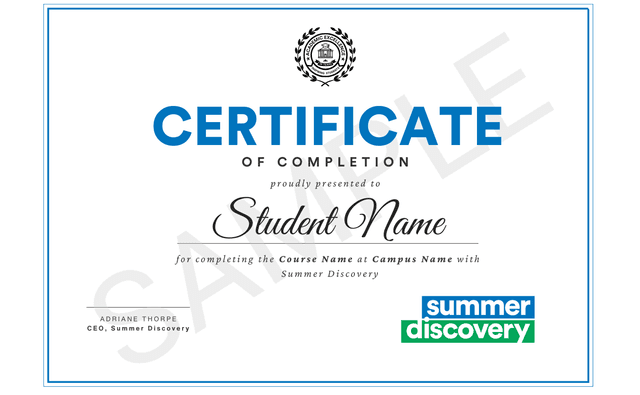
Summer Discovery Certificate of Completion
After successfully finishing this course, you will be awarded a certification of completion for your accomplishment.
*This is a preview, not what you will receive
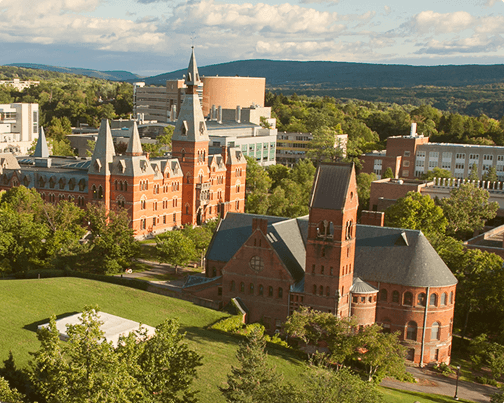
Cornell University
Cornell University